
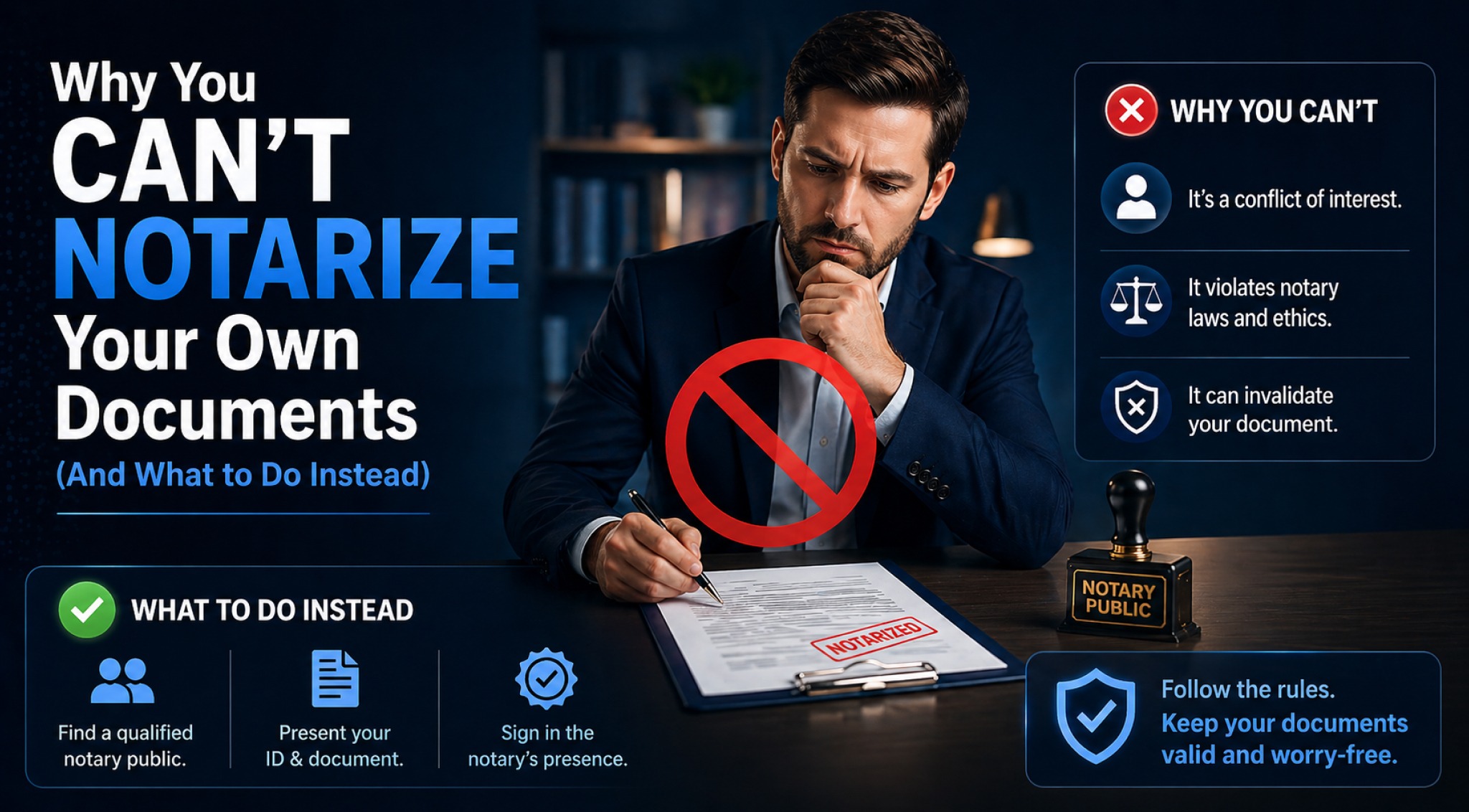
Ever thought about skipping the hassle and trying to Notarize Documents yourself?
It might seem like a quick shortcut, no appointments, no waiting, no extra steps. But not legally. One of the most common questions people ask is: Can you notarize your own documents? And the answer is no, for reasons you may not appreciate.
Notarization is not merely an administrative process; it is a system of trust, verification, and accountability. Attempting to circumvent it can result in document rejection, application delays, and even legal issues. So before you try to do it yourself, let’s take a look at how it works.
Can You Notarize Your Own Documents?
The short answer is that you can’t notarize your own documents.
Even if you are a licensed notary, you cannot notarize any document in which you have a personal interest. It is because notarization is impartial. The notary’s job is to be an independent witness to the signing of the document, to verify identity and willingness to sign, and to ensure that the document is signed without pressure or fraud.
Being part of the document undermines that neutrality. That’s why the law bars the signer from being the notary. So, even if it seems tempting, to notarize documents yourself is contrary to the whole purpose.
Why the Law Doesn’t Allow It
The rule may seem harsh at first, but there’s a good reason for it. Notarization is important to ensure security and trust in legal and financial transactions.
When a notary is involved, they are expected to:
- Verify the identity of the signer
- Make sure the signer understands the document
- Make sure the document is being signed voluntarily
You can’t do this if you’re signing your own document. There’s a conflict of interest, and the notarization lacks credibility.
This is why legal systems around the world enforce this rule. It means when you notarize documents, it is reliable, uniform, and legitimate.
What Happens If You Try to Do It Anyway?
Notarizing your own document may seem like an innocent solution, but it could cause problems in the future.
For instance, your document could:
- Not accepted by legal bodies or organisations
- Not accepted in official transactions
- Slow down transactions such as property transfers and agreements
And if you’re a registered notary, there can be more severe consequences, such as fines or penalties.
Often, people only find out too late, when their document is rejected or called into question. That’s why it’s important to do things right the first time, rather than having to correct errors.
What You Should Do Instead
The correct approach is simple: always use an independent, certified notary.
This guarantees your document will be verified and valid. But if the prospect of visiting an in-person notary seems like a hassle, there’s another option.
These days, you can notarize documents online using secure services that link you with notaries. Platforms like EzoSign enable you to do this all through a video call, which means no need to take time out of your busy schedule.
How Online Notarization Makes It Easier
Rather than wondering if you can notarize your own documents, it’s more important to ask how you will do it right and fast.
Online notarization simplifies everything. You submit your document, prove your identity, and then meet with an online notary – all in one go. It is step-by-step, so you can’t miss anything.
It also provides an element of certainty that is often lacking. The process is recorded, time-stamped, and encrypted. This provides an audit trail that can be invaluable if there are questions about the document.
Digital notarization is not only an alternative to the traditional method, but it’s an improvement.
When Do People Usually Ask This Question?
This question may be asked in circumstances where people want to save time or make things easier.
Common scenarios include:
- Signing personal affidavits
- Handling business contracts
- Filling out real estate papers
- Managing financial agreements
Regardless of the circumstances, the same principle applies: you can’t notarize your own document. You always need to have it notarized by an independent notary.
Final Thoughts
Trying to notarize documents on your own might seem like a shortcut, but it ultimately creates more problems than it solves. Notarization is built on trust and neutrality, and those elements can’t exist if you’re both the signer and the notary.
The smarter approach is to use a process that’s both simple and legally sound. With modern solutions like EzoSign, you can complete notarization quickly, securely, and without unnecessary stress, while ensuring your documents are fully valid and ready to use.
No, even licensed notaries cannot notarize documents in which they have a personal interest.
Because it creates a conflict of interest and removes the impartial verification required for legal validity.
You should always use a certified, independent notary, either in person or through an online platform.
Yes, it is legally recognized in many regions and provides a secure way to Notarize Documents remotely.
It may be rejected or considered invalid, leading to delays or legal complications.